Let's Clear Up The Confusion:
Folic Acid versus Bioactive Folate
Even if your daily diet doesn't include 6-8 servings of fresh
fruits and vegetables, you can still give your body the form
of folate it prefers most. HS Fighters Active B Vitamins™
are made with BioAactiv Folate™
(an ingredient so unique, it's patented) --- the naturally
occurring active form of folate you get every time you eat
green leafy vegetables. Understanding the difference between
Folic Acid and Bioactive Folate is important, so please continue
reading...
Are You Converting Folic Acid to Active Folate?
Folic acid is often labeled folate or folicin. However, none of these are the
active form of folate (known as L-5-MTHF or l-methylfolate) your body
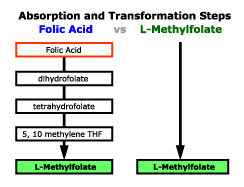
can absorb and put to work. It takes four separate biochemical reactions
for your body to turn folic acid into active folate:
Conversion of folic acid into active folate is frequently disrupted by genetic factors, age-related problems and metabolic obstacles.
Up to 40% of adults are affected by an inherited genetic trait that limits the amount of folic acid converted to the active form of folate our body prefers.
Take More Folic Acid?
Some people try to overcome the obstacles to transforming folic acid by taking doses of 800 mcgs or higher. Transformation of folic acid into active folate falls off after ingesting 200 mcg, and is saturated at doses in the region of 400 mcg. When folic acid fails to be converted to active folate it remains in the bloodstream for days, even weeks at a time. Nutrition researchers are investigating whether "unused" folic acid in the bloodstream actually blocks the absorption of folate from natural sources such as green leafy vegetables.
Conclusion
If testing your blood and cell tissue to confirm your active folate status
doesn't thrill you, here's an intelligent alternative: let
your body bypass the four-step conversion of folic acid by
giving your body the exact form of folate it prefers and can
immediately absorb -- the BioActive Folate in HS Fighters
Active B Vitamins™.
The decision to exclude folic acid from the HS Fighters
Active B Vitamins formula, in favor of high-absorption
BioActive Folate™,
was made for these key reasons:
- BioActiv Folate™
is the naturally occurring form of folate your body prefers
- BioActiv Folate™
bypasses obstacles to absorbing folic acid and does not
accumulate in the blood like folic acid
- BioActiv Folate™
is so unique, the ingredient is protected under law by a
U.S. Patent (as Metafolin®)
- BioActiv Folate™
has been safety tested as a dietary ingredient and registered
with the FDA (as Metafolin®)
- BioActiv Folate™
is produced by a world leader in folate nutrition
|